



VFV Laboratory
Laboratory analyses in Skopje.
Website for a diagnostic laboratory in Skopje.
About this project
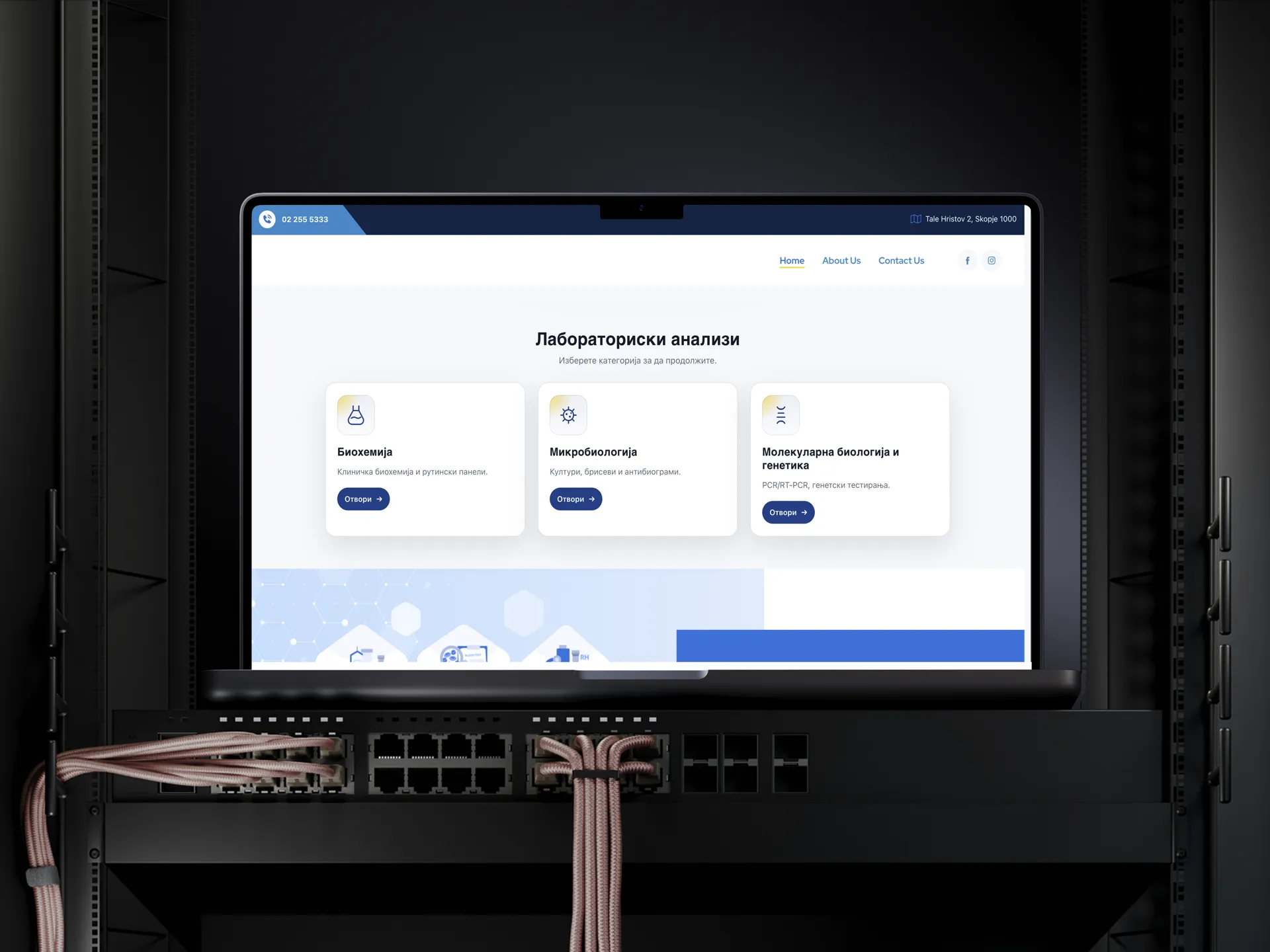
VFV Laboratory is a full-service diagnostic laboratory in Skopje, operating from Tale Hristov 2 with a scope that covers biochemistry, microbiology, and molecular biology and genetics, including PCR and RT-PCR testing and advanced genetic panels. Their test catalogue spans more than fifty diagnostic panels: stool analysis, drug screening, hemostasis, tumor markers, autoantibodies, allergy testing, hormonal panels, cardiac and anemia markers, urine and glucose metabolism, lipid profile, and more. Prices are published in MKD. Opening hours run Monday through Friday from 7:00 to 18:00 and Saturday from 7:00 to 15:00. Patients can book by phone (02 255 5333) or reach the team by email (vfvlabrezultati@gmail.com). The project came to us as a ground-up build. VFV had clinical credibility (qualified staff, a broad catalogue, and a home collection service that most competitors in North Macedonia either do not offer or do not advertise clearly) but no digital presence that reflected it. Patients searching for a specific test, a price, or a way to book were hitting a wall. Our job was to turn a complex service catalogue into something a patient on a phone, anxious about a health question, could navigate in under a minute. That meant decisions at every level: how to name tests (clinical names alone exclude most patients; common-language names alongside clinical labels serve both audiences), how to group fifty-plus panels into categories that match how people think about their health rather than how labs classify internally, and how to surface home collection, a genuine differentiator, as a primary option rather than a footnote. The result is a site built around patient intent. The information architecture starts with the question a patient has (what kind of test do I need) and walks them through categories, specific panels with prices in MKD, and a direct path to book or request a home visit. Opening hours appear where patients need them, not buried in a contact page. The site loads fast on mobile because that is where the searches happen. VFV now has a digital presence that matches their clinical standard.
The Challenge
Diagnostic laboratories occupy a difficult position in healthcare communication. A patient visiting the site is rarely browsing: they have a referral, a symptom, or a test name they have been given by a doctor, and they need three things quickly: confirmation that this lab offers the test, the price in local currency, and a clear way to book. Anxiety is a real factor. When someone is searching for tumor markers or genetic panels, clarity and confidence in the source matter as much as the information itself. VFV Laboratory had the clinical capability (a broad catalogue across biochemistry, microbiology, and molecular biology, qualified staff, and a home collection service that is rare in the North Macedonia market) but no website that communicated any of this. Without a digital presence, patients defaulted to larger or better-known competitors simply because they could find information there. The specific challenge was not just building a website but making a catalogue of more than fifty test panels navigable to a general audience. Diagnostic categories that are clear to a clinician (hemostasis, autoantibodies, molecular genetics) are opaque to most patients. Test names in Latin or abbreviated clinical shorthand (PCR, RT-PCR, OGTT) need context to be useful. Pricing in MKD needed to be present and credible without undermining the professional tone. And home collection, the single feature most likely to drive a booking decision, was invisible because there was no site to feature it on. The problem was equal parts information architecture, content strategy, and trust design.
Our Approach
We built the VFV Laboratory site from the ground up, starting with content architecture before any design work. The first task was organising the test catalogue into categories that map to patient intent rather than internal lab classification: allergy testing, hormonal panels, cardiac markers, and genetics each represent a distinct patient concern and needed their own clear landing point. Test naming was a deliberate content decision. We used plain-language labels as primary headings with clinical names alongside them, so a patient searching for a blood sugar test and a clinician requesting an OGTT both land in the right place. Prices in MKD are shown alongside each panel: not behind a call-to-action, not on a separate pricing page, but directly in context, because price transparency is a conversion driver and a trust signal in this market. Home collection is treated as a first-class feature throughout the site. It appears in the hero, in service descriptions, and at every booking decision point, because it is a genuine differentiator in Skopje and patients who need it will choose the lab that makes it visible. The booking flow is minimal by design. Patients can reach the lab by phone or email from any page. Opening hours (Monday to Friday 7:00–18:00, Saturday 7:00–15:00) are placed where decisions are made, not hidden in a contact footer. The build was mobile-first throughout. Most searches for local diagnostic services in North Macedonia happen on a phone, often in a moment of urgency. Page weight, tap targets, and content hierarchy were all optimised for that context. The outcome is a site that works as both a service directory and a trust-building tool, presenting clinical depth while remaining usable by any patient, regardless of their familiarity with diagnostic terminology.
Project images
How we did it
- 01
Scope and content
2 weeksDefined structure, categories, services, pricing in MKD, and booking flow with VFV Laboratory.
- 02
Design and build
6 weeksBuilt the site with categories, service list and prices, booking, home collection, and contact.
- 03
Launch
1 weekGo-live and handover.
Respekt për ju! Të përkushtuar dhe profesionist! VLERËSOJ punën serioze që bëni.
Related Services
Frequently Asked Questions
What was built for VFV Laboratory?
How long did the VFV Laboratory project take?
What technologies were used to build VFV Laboratory?
What was the main challenge with the VFV Laboratory project?
How did Zulbera approach the VFV Laboratory project?
Ready to build
something great?
Whether it's a new product, a redesign, or a complete rebrand, we're here to make it happen.
Trusted by Novem Digital, Revide, Toyz AutoArt, Univerzal, Red & White, Livo, FitCommit & more