



The Problem with Fitness Apps
The fitness app market is saturated with products that feel interchangeable. Most follow the same template: a library of workout videos, a calorie counter, and generic push notifications that say "Don't forget to work out today!" The result is an industry where the average app loses 77% of its users within three days of download.
FitCommit's founders understood this problem intimately. They had tried every major fitness app and found the same pattern: initial excitement, declining motivation, and eventual abandonment. The missing ingredient was not more content or more features — it was a compelling emotional connection to the outcome. People do not quit because they lack exercises to do. They quit because the future benefit feels abstract and distant.
The idea was simple and powerful: what if you could see your future self? Not an abstract promise, but a visual representation of what you could look like if you followed through. That single concept — making the invisible visible — became the foundation of FitCommit's entire product strategy.
The Challenge
Building FitCommit presented three distinct challenges that had to be solved simultaneously:
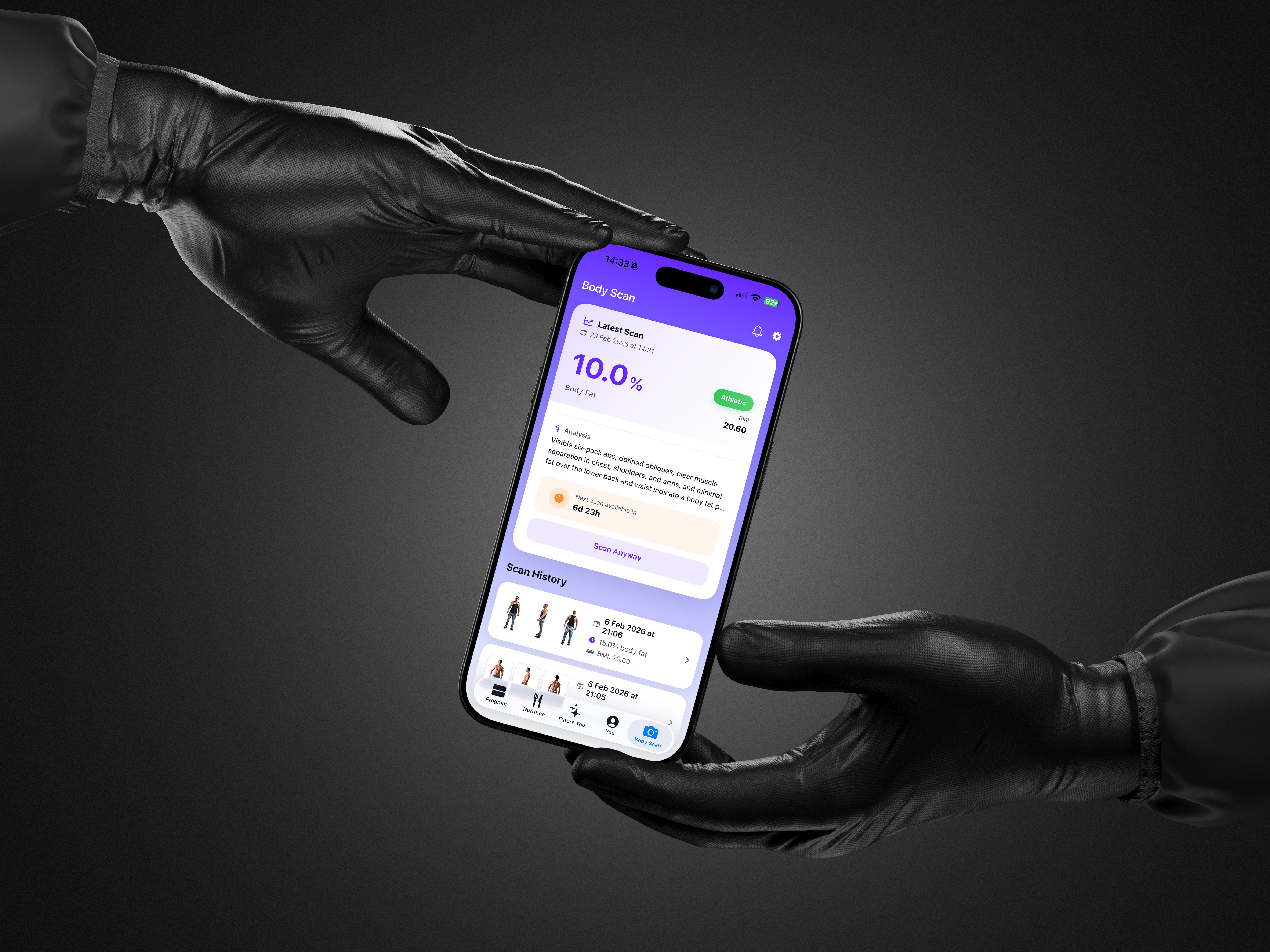
The visualization engine. The "see your future self" feature had to feel realistic enough to be motivating but honest enough to be credible. Users would share these visualizations with friends and on social media — if they looked fake or generated by a simple filter, the core value proposition would collapse. The engine needed to consider body type, current fitness level, and realistic transformation timelines.
Cross-platform performance. FitCommit needed to be on both iOS and Android from day one — the fitness market does not tolerate platform exclusivity. But maintaining two native codebases would double the development cost and halve the iteration speed. The framework choice had to deliver native-quality animations and camera access without compromising on either platform.
Retention mechanics. Downloads are vanity metrics. The real challenge was engineering retention: getting users past the critical first week, building habits that stick, and creating engagement loops that feel helpful rather than annoying. Every notification, every progress update, every interaction had to earn its place in the user's attention.
Our Approach
Phase 1: Discovery & User Research (2 weeks)
We started by auditing the top 20 fitness apps on both stores, mapping their onboarding flows, retention mechanics, and the specific moment where most users dropped off. The pattern was consistent: apps that front-loaded feature complexity lost users fastest. Apps that delivered an emotional payoff in the first session retained best.
This insight shaped our entire architecture. The body visualization feature would be the first thing users experienced — not buried behind account creation, workout selection, or profile setup. We designed the onboarding flow to deliver the "future self" visualization within 60 seconds of opening the app for the first time.
Phase 2: Design & Development (10 weeks)
We chose React Native with TypeScript as our cross-platform framework. For FitCommit, the decision was clear: the app needed to share business logic and UI components across platforms while accessing native camera APIs for progress photography. React Native delivered 95% code sharing between iOS and Android with no compromises on the interactions that mattered most — smooth scrolling through workout plans, fluid transitions between visualization states, and responsive haptic feedback on milestones.
The body visualization engine was the technical centerpiece. We built it as a modular component that takes the user's input data — current measurements, target goals, and timeline — and generates a realistic projection. The visualization updates progressively as users log workouts and track measurements, creating a visual feedback loop that reinforces consistency.
Progress photography was designed as a first-class feature, not an afterthought. The app guides users through consistent photo positioning with overlay guides, stores photos with encrypted local storage, and assembles them into transformation timelines that users can share. These shareable moments became FitCommit's most powerful organic acquisition channel.
The backend API was built in Node.js with TypeScript, optimized for mobile consumption: compact JSON responses, efficient pagination for workout history, and real-time sync that handles offline-first scenarios gracefully. Push notification infrastructure was built from the start with behavior-driven triggers rather than time-based schedules — notifications fire when users hit milestones, complete streaks, or when their visualization updates with new data.
Phase 3: Launch & Optimization (2 weeks)
App Store assets were prepared in parallel with development — keyword-optimized titles, compelling screenshots generated from real app states, and preview videos that demonstrated the body visualization feature in under 10 seconds. Privacy nutrition labels and data handling declarations were documented during development, ensuring a smooth review process.
We ran a TestFlight beta with 200 users for 10 days before public launch. The beta revealed two critical insights: users who completed the visualization in their first session had 3x higher 7-day retention, and users who took their first progress photo within 48 hours had 2x higher 30-day retention. These findings shaped our final onboarding nudges.
Technical Architecture
Results
FitCommit launched on both iOS and Android simultaneously and reached 50,000+ active users. The app maintains a 4.8-star rating across both stores — a metric that directly impacts App Store search ranking and conversion rates. User retention exceeds industry averages by 65%, driven primarily by the body visualization feature and behavior-driven engagement mechanics.
The progress photography sharing feature became the app's primary organic growth channel, with user-generated transformation content driving downloads without paid acquisition spend. The shareable visualizations create a natural viral loop: users share their projected results, their friends download the app to see their own, and the cycle continues.
Project Timeline
Discovery & User Research
Audited top 20 fitness apps. Mapped retention patterns and identified the first-session aha-moment strategy. Defined body visualization UX and progress tracking flows.
Design & Development
Built React Native app with TypeScript. Body visualization engine, progress photography, habit tracking, workout plans. Node.js backend API with push notification infrastructure and offline-first sync.
Launch & Optimization
TestFlight beta with 200 users. App Store assets, privacy declarations, and metadata optimization. Onboarding flow refinement based on beta retention data. Simultaneous iOS and Android launch.
FitCommit finally makes fitness goals feel real. Seeing the possible version of yourself is incredibly motivating.
FitCommit Team
Product, FitCommit
Lessons Learned
Front-load the emotional payoff. The decision to make body visualization the first interaction — before account creation, before workout selection — was the single most impactful design choice. Users who experienced the visualization in their first session retained at 3x the rate of those who did not.
Notifications should be earned, not scheduled. Time-based push notifications ("It's 6pm, time to work out!") feel like nagging. Behavior-driven notifications ("You just completed a 7-day streak!") feel like celebration. The difference in user response is dramatic, and it shows directly in retention curves.
Shareable moments are the best marketing. We did not build a "share" button and hope users would use it. We designed specific moments — the first visualization, streak completions, transformation timelines — to be inherently shareable. Each shared moment is also a product demo, showing the recipient exactly what the app does and why they should try it.